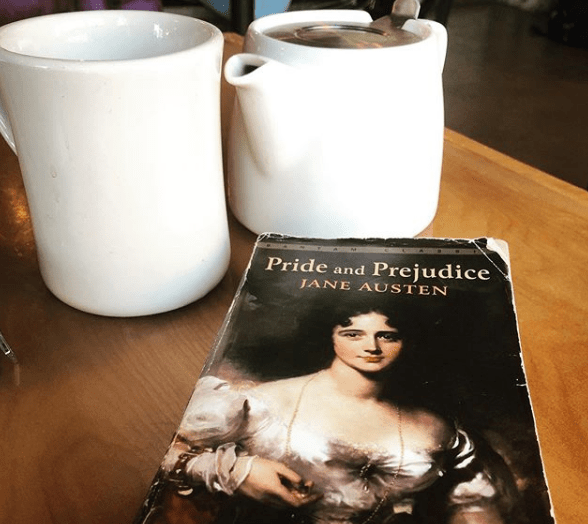
Anne’s Review
I have to confess, the first time I fell in love with Pride and Prejudice was not as a book, but as a BBC series. When I was in fourth grade, I tuned into PBS’ British Masterpiece Theater on a Sunday night with my mother the night they aired the 1995 Pride and Prejudice adaptation. It was then my obsession with Jane Austen’s most acclaimed novel began. As a young reader, I initially found the book a bit off-putting due to its complex early 1800s language, (how long is a fortnight anyway?). For others who may be turned off by the novel due to the language, I strongly recommend giving the movie or series ago, it can help put even the most confusing 19th-century social digs into context. Also, I know this is meant to be a book review, but the 1995 BBC series of Pride and Prejudice is so much better than the 2005 movie adaptation with Keira Knightly. Disagree? Fight me. *Preferably in the comments below.* But I digress.
It wasn’t long before I began to appreciate and understand the subtle and wittily written digs delivered by the novel’s heroine Elizabeth Bennet. And despite the centuries of changing social norms and values separating us now and the time when Austen wrote this novel, many of themes and characterizations are still very relevant to today. A hairbrained mother who drives you crazy, annoying younger siblings, a family you’d prefer not to be associated with in public, and pompous rich people who think they’re above poor and middle-class folk? Check, check, check, annnnd check. Yes, those sometimes wonderful and frustrating themes and people still exist today, which is a part of what makes this book a classic and relevant more than ever. Not to mention there’s a brooding, attractive, rich guy with a stellar British accent, (a character great in books but probably terrible in real life,) who gets ultimately owned and taught some humility by a smart young woman. How many times have we, as a society, dreamed of doing that?
A hairbrained mother who drives you crazy, annoying younger siblings, a family you’d prefer not to be associated with in public, and pompous rich people who think they’re above poor and middle-class folk? Check, check, check, annnnd check.
One criticism I want to briefly address that’s often said about all of Austen’s novels is the lack of reference to any British politics or events. *Hello, Napoleonic Wars, War of 1812, etc.* Though Austen frequently mentions the regiment and features a British soldier, Mr. Wickham, nothing is said of the wars or current politics. As a history lover myself, this doesn’t personally bother me so much as I believe politics would draw from the main story’s plot. The novel does focus on some of the class issues of the time, so I personally I believe much of this criticism is drawn from those who personally don’t enjoy the drama of this 19th-century love story. However, if you are expecting something more along the lines of a Charles Dickens novel, this book may not appeal to you as much as a hopeless romantic or British procedural loving person like myself.
Overall Rating: 4 out of 5 stars
 Travel by the Book